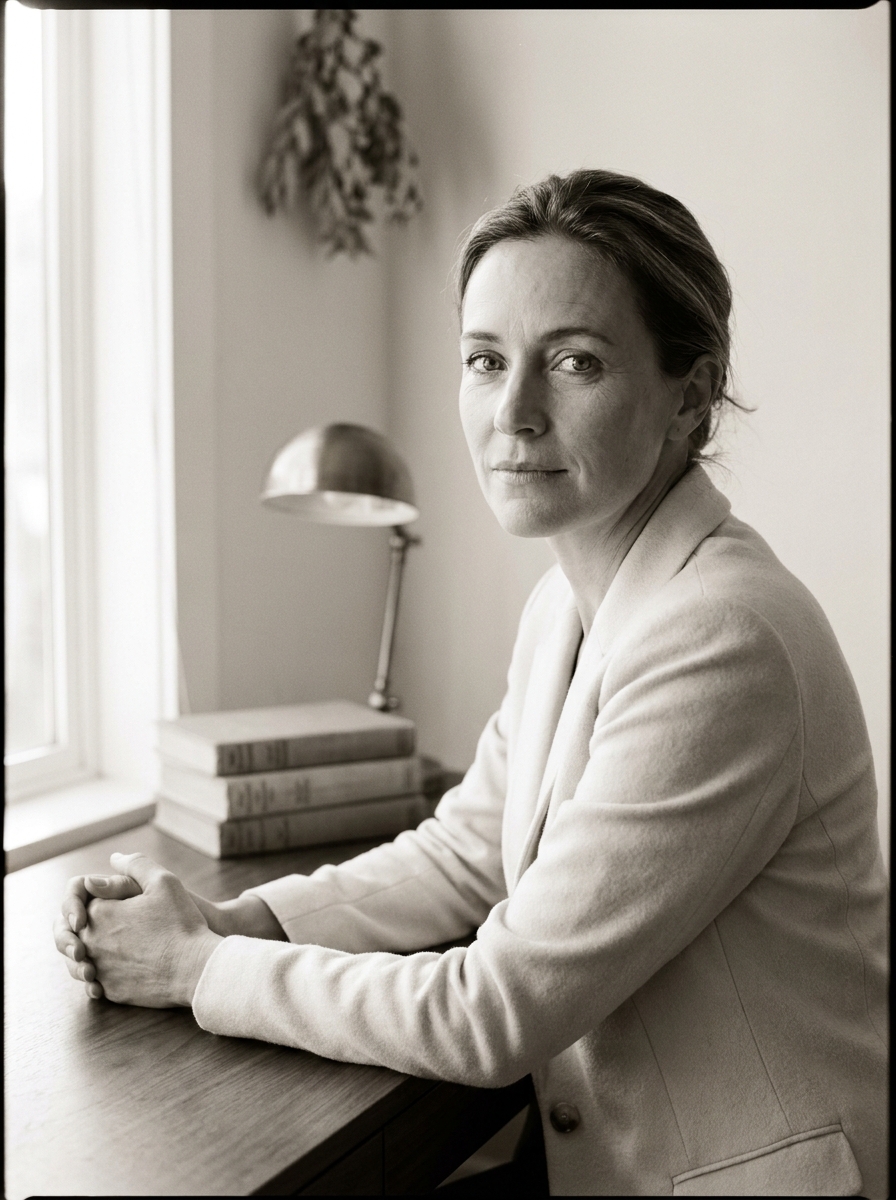
N° I · The Founder
Dr Léa Aboulafia.
GMC
MRCS
BAAPS
14 yrs
She founded the Maison in MMXXIII, on the conviction that a serious aesthetic clinic should ask fewer questions, more carefully — and that the most consequential answer is, very often, "leave it alone."
Léa Aboulafia trained as a facial plastic surgeon at the Hôpital Saint-Louis in Paris, where she spent four years under Professor Jean-Luc Dervaux in the reconstructive faculty before crossing the Channel for a senior fellowship at the Royal Free, London. Friends still tease her about how the move was meant to be six months. It became fourteen years.
She trained in reconstruction first, and aesthetic medicine second — an order she insists is the right one. "If your earliest cases are people who have lost a face to fire or to cancer," she has written, "you arrive at aesthetic practice with a different sense of proportion. You stop believing the face is something to be improved upon, and start understanding it as something to be quietly defended."
By MMXX, she had spent six years as a senior physician in two of London's most-respected private practices, and had begun to keep, almost compulsively, a small notebook of the things she would do differently if she had a clinic of her own. The notebook ran to seventy-two pages, indexed in pencil. Most of the entries were about pace.
"The problem was never the medicine," she says now, of the years before. "The medicine was excellent. The problem was the appointment book — it ran the medicine. I wanted to run the medicine, and let the appointment book follow."
Maison Aesthetica opened on Bruton Street in the autumn of MMXXIII, in a small first-floor suite of a Georgian townhouse around the corner from Berkeley Square. There is one consultation room and one treatment bay. By design, no more than eleven sessions are conducted in a single week. The waiting list, she will tell you, runs to between six and eight weeks for a first reading.
In her second year of practice she began collaborating with Dr Yuki Marchetti, a computational anatomist trained at Imperial College and the Stanford AI Lab, on what would become the Maison's in-house diagnostic system, Mirror. Mirror reads one hundred and ninety-two anatomical points across the face in approximately three minutes, and proposes — never decides — a treatment direction. Aboulafia is firm about the verb. "It proposes. We decide. The day a system decides is the day I close the practice."
Three London houses now license Mirror, in confidence. Aboulafia will not name them and will not, when asked, even confirm how many times the Maison has been approached by other practices. "We are not in the business of building software," she has said. "We are in the business of running a small house. The licensing arrangements are, for us, an interesting accident."
She published her first book, The Quiet Face, with Rizzoli in MMXXIV — a collection of essays on the philosophy of restraint in modern aesthetic medicine. A second volume, on the long-form treatment plan as an act of architectural patience, is expected in late MMXXVI.
She lives in Marylebone with her partner and a Pomeranian named Bertrand, swims at the RAC most mornings, and is rarely seen at industry conferences. She prefers, she says, to be at the practice. "There is, in the end, no shortage of more interesting places to be than a stage."
A face is not a problem to be solved. It is a long sentence, written slowly, that needs only to be punctuated correctly.
Most of what we are asked for is not what is needed. Most of what is needed has not yet been asked for. The work is in noticing the difference.
The day a diagnostic system decides on a patient's behalf is the day this profession should be ashamed of itself. Mirror proposes. We decide.